
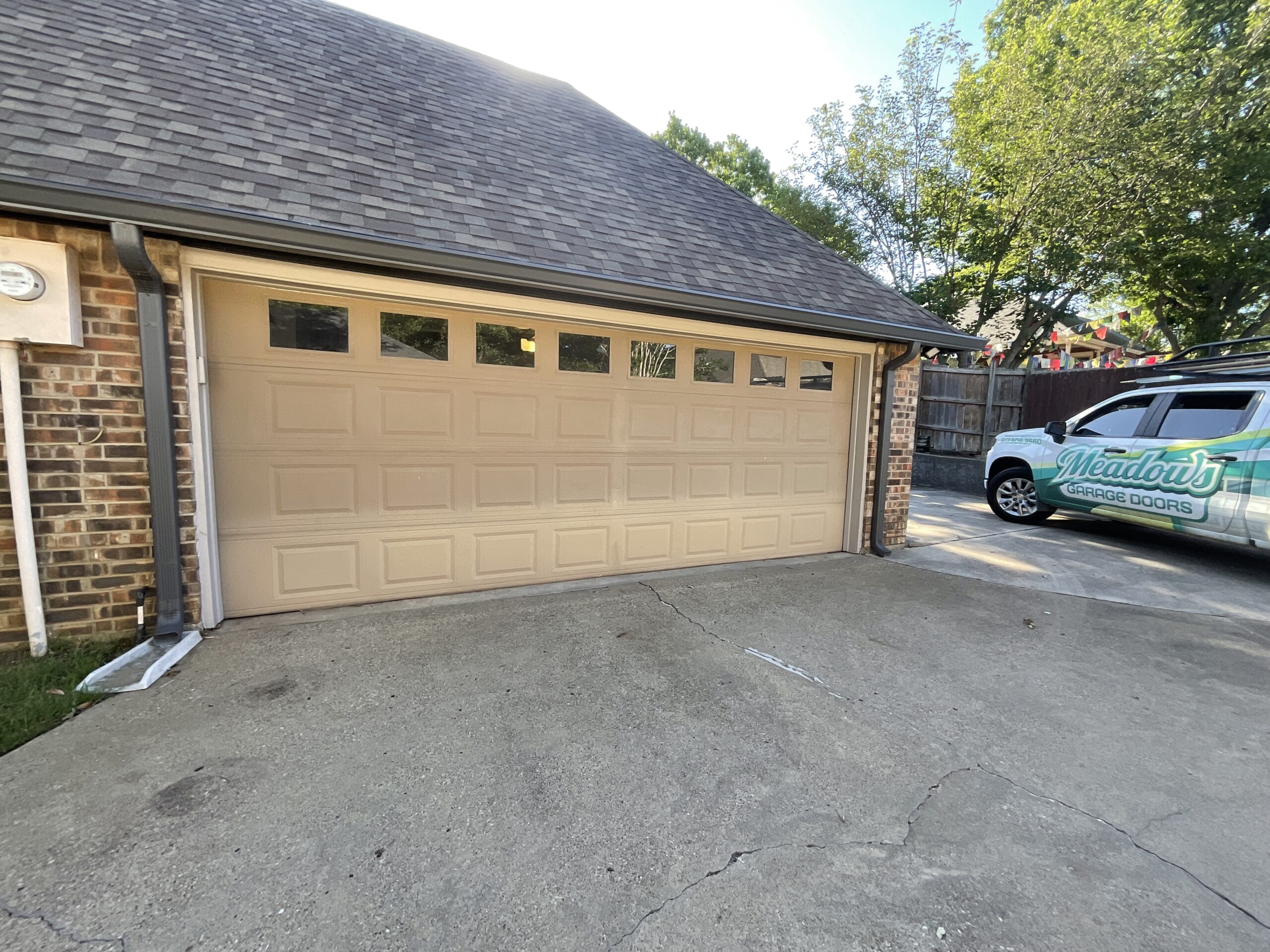
One of the most common calls we get in August: A garage door that starts to close, then stops and rolls back up. The heat is not a coincidence. When the temperature in a Trophy Club or Keller garage climbs past 100 degrees, the metal, the sensors, and the opener all behave differently than they do in March. For comprehensive help, see our garage door repair services.
Most of the time the door is not broken. Something is out of alignment or overworked, and the door’s safety system is doing its job by refusing to close. The question is whether a quick check fixes it, or the problem needs a technician.
Why heat makes a garage door reverse
Did you know that different garage door materials hold up differently in heat? Not just the outward material is impacted by Texas summers though, the internal mechanisms can be impacted too. Three things happen when a Texas garage gets hot, and they often happen at the same time.
First, the metal track expands. A steel track that runs the full height of the door can grow by a fraction of an inch in direct heat. That small change is enough to make the rollers bind against the track. When the door feels resistant, the opener reads it as an obstruction and reverses. Garage opening but not closing? Check out this article for more information.
Second, the photo-eye sensors drift. These are the two small units near the floor on either side of the opening. Heat softens the brackets that hold them, and a door that gets bumped or vibrated can knock one sensor slightly out of line. When the beam between them breaks, the door will not close.
Third, the opener motor strains. A motor that has been running all summer in a hot garage works harder to lift the same door. Springs that are near the end of their life add to the load. The opener’s force settings, which were fine in cooler weather, can trip the reverse function when the motor is hot and the door is heavy.
The quick checks you can do yourself
Before you call anyone, there are a few things worth looking at. These are checks, not repairs. If any of them points to a real problem, stop and call a pro.
Start with the sensors. Look at the small lights on each photo-eye unit. Both should be lit and steady. If one is blinking or dark, the beam is broken. Wipe the lenses with a dry cloth and make sure nothing is leaning against the sensor or blocking the path. A broom, a bike, or a box that has shifted can sit right in the beam.
Next, look at the track. Run your eyes down both sides and check for anything that looks bent, loose, or pushed inward. A track that has been hit by a car bumper or a lawn mower will bind the rollers. You can spot a gap where the track has pulled away from the wall.
Then check the door’s balance. Pull the release cord so the door runs by hand, and lift it halfway. A door that stays put is balanced. A door that drops or shoots up has a spring problem, and that is not something to fix on your own.
When the problem is not a quick fix
Some reversals are a sign that a real repair is coming. Here is how to tell the difference.
If the door reverses only in the late afternoon, when the sun is directly on the track, the cause is likely thermal expansion. That is a nuisance, but it usually clears once the track cools. If the door reverses at any time of day, in any weather, the cause is more likely mechanical.
A door that reverses and also makes a grinding or popping sound is telling you the springs or cables are failing. A door that reverses and then will not open again has a motor or logic board issue. A door that reverses and leaves a gap at the bottom, or sits crooked, has a track or roller problem.
None of these are safe to ignore. A garage door is the largest moving object in most homes. When it starts behaving unpredictably, the risk is more than a stuck car. It is a door that could fall unexpectedly.
Why you should not keep resetting the opener
It is tempting to hold the wall button down and force the door closed. That overrides the safety reverse, and it works, for a while. The problem is that you are now closing a door that the system has already told you is unsafe.
Forcing the door masks the real issue. The spring keeps wearing. The track keeps binding. The sensor keeps drifting. One day the door closes on a car, or worse, and the repair bill is far higher than it would have been if you had called when the reversing first started.
The reverse function is not an annoyance. It is the door telling you something is wrong. Listen to it.
When to call right away
Some situations should not wait for a convenient time. Call us the same day if any of these are true.
The door will not close at all, and your car is trapped inside. The door reverses and then slams or drops a few inches. You see a broken spring or a frayed cable. The door is crooked in the opening. Or the door reverses and you hear a loud bang.
These are the calls we prioritize, because a door that cannot close leaves your home open, and a door that drops is a hazard. We keep same-day slots open for exactly these situations.
What a Meadows service call actually looks like
When you call us about a reversing door, we do more than reset the opener and leave. We check the whole system, because a reversing door is usually a symptom of something else.
A technician will test the balance, inspect the springs and cables, check the track alignment, and verify the sensor beam. We adjust the force and travel limits on the opener so the door closes fully without tripping the reverse. If a spring is worn or a cable is frayed, we tell you before we touch it, and we give you a price before any work starts.
We are a locally owned company based in Trophy Club, and we have been repairing doors across the DFW area with thousands of satisfied customers. We serve Southlake, Keller, Flower Mound, Frisco, and the surrounding communities. Every job is done by our own licensed and insured technicians. We never subcontract the work.
The bottom line
A garage door that reverses in the Texas heat is usually fixable, and often it is a simple adjustment. The key is figuring out whether the cause is a hot track or a failing spring, and that is where a trained eye matters.
If you have checked the sensors and the track and the door still will not close, call Meadows to schedule a service call. We will find the cause, explain it in plain terms, and give you a price before any work begins. Your door should close the way it is supposed to, even in August. Schedule a garage door repair service call today.