
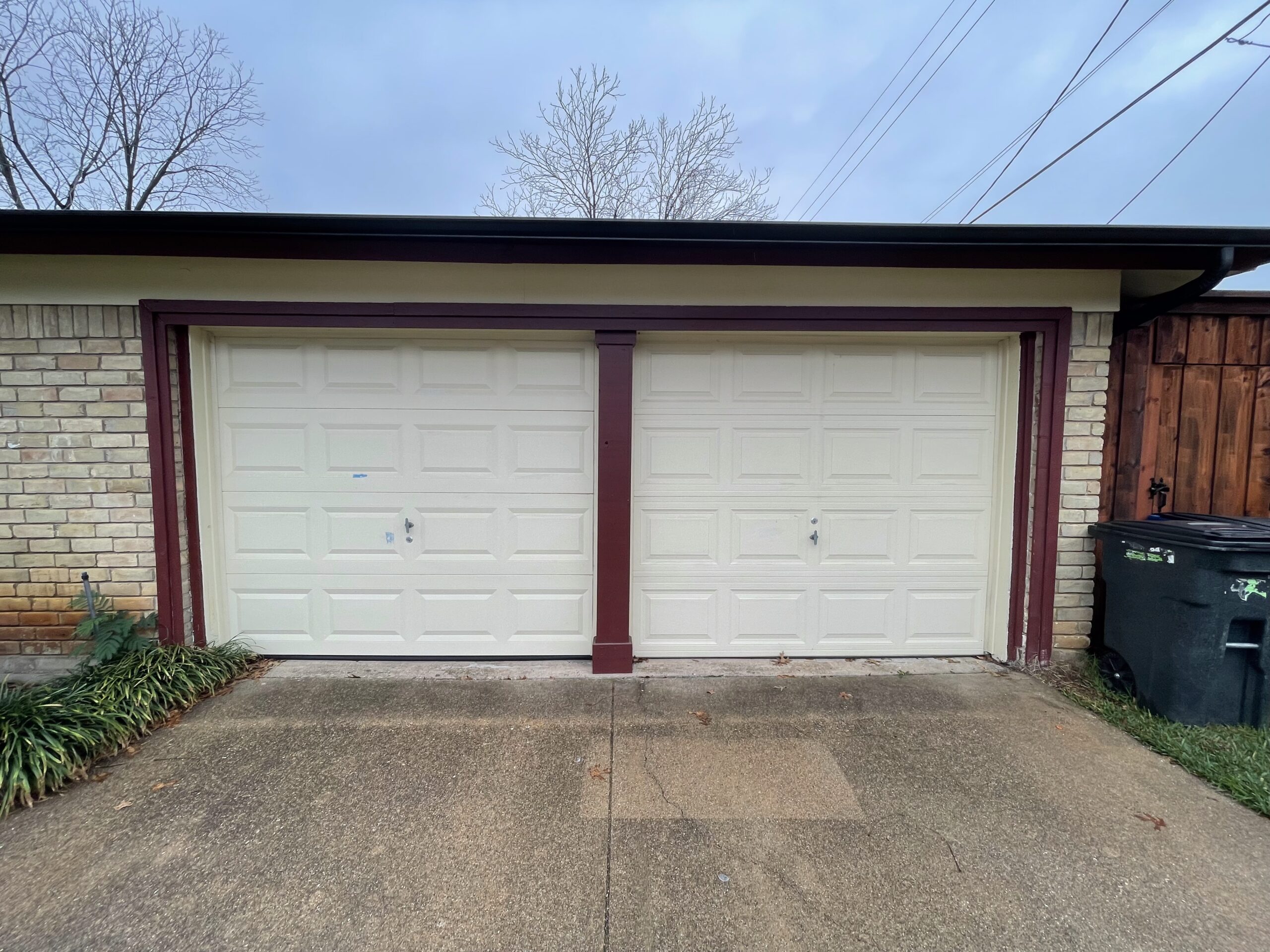
You walk into your garage on a sunny afternoon and notice a thin line of light cutting across the floor. Or you feel a draft against your ankles on a winter morning. Seeing daylight through your closed garage door is not just a cosmetic issue. It is a signal that something in your door’s sealing system, alignment, or structure has failed.
For homeowners in Trophy Club, Keller, Southlake, Flower Mound, and across the DFW area, gaps around the garage door create problems that extend far beyond the garage itself. Texas heat, sudden cold fronts, and seasonal storms all exploit those openings, driving up energy costs and exposing your home to water, pests, and dust.
Why Gaps Matter More in North Texas
The DFW climate puts garage doors through an extreme test. Summer temperatures routinely climb past 100 degrees, and the sun beats directly on south- and west-facing doors for hours. In the winter, sudden arctic fronts can drop temperatures into the teens overnight. A door that cannot seal properly forces your home’s heating and cooling system to work harder to compensate for the constant exchange of air between the garage and the outside.
Gaps also provide entry points for fire ants, scorpions, mice, and snakes, all of which are common in the North Texas landscape. Water intrusion during heavy rains can damage stored items, corrode metal fixtures, and seep into the framing of your home.
Even a small gap can have a surprisingly large impact. A one-quarter-inch gap along the bottom of a standard two-car garage door is equivalent to a five-inch square hole in your wall. That is a significant breach in your home’s thermal envelope.
The Cost of Ignoring Garage Door Gaps
A small gap may seem like a minor annoyance, but the cumulative cost adds up quickly. According to energy experts, an unsealed garage door can increase a home’s heating and cooling costs by 10 to 20 percent, especially if the garage shares a wall with a living space. In North Texas, where air conditioning runs for months at a time, that translates to hundreds of dollars per year.
Pest control is another hidden cost. Mice, rats, and insects entering through gaps can damage stored items, chew wiring, and create nests inside walls. A single mouse colony can produce dozens of offspring in a matter of weeks. Preventing entry is far cheaper than hiring an exterminator.
Water damage is the most expensive consequence. Even a small amount of water intrusion during a heavy rain can warp subflooring, corrode metal, and promote mold growth. Remediation costs for mold and water damage routinely run into the thousands.
The Four Types of Garage Door Gaps
Not all gaps are the same. Where the gap appears tells you what has failed and how urgently it needs to be addressed.
Side Gaps
Gaps running vertically along the left or right edge of the door typically indicate one of three problems. The weatherstripping along the door jamb may have compressed, cracked, or torn away from the frame. The door itself may have shifted out of plumb, meaning it is no longer hanging perfectly vertical. Or the tracks may have loosened or bent, causing the door to close at an angle rather than flush against the frame.
Side gaps are particularly common after a door has been struck by a vehicle, hit by wind-blown debris, or subjected to years of vibration from an unbalanced opener. In neighborhoods around Keller and Trophy Club, where homes are often built on shifting clay soils, foundation movement can gradually pull door frames out of place.
If you notice the gap is wider at the top or bottom than in the middle, track misalignment is the likely cause. If the gap runs evenly along the entire side, the weatherstripping has probably failed.
Top Gap
A gap across the top of the door usually points to a header seal failure or a door that is not closing fully. The header seal is a rubber or vinyl strip mounted to the frame above the door. Over time, UV exposure from the Texas sun degrades the material, causing it to harden, shrink, or crack.
If the header seal looks intact but the door still does not reach the top of the frame, the opener limit settings may need adjustment. The opener is stopping the door before it reaches the fully closed position. Alternatively, debris on the tracks or binding rollers can prevent the door from traveling its full distance.
Top gaps are often accompanied by noise. If the opener strains or the door bounces at the end of its travel, the limit settings are almost certainly off.
Bottom Gap
The most common and most problematic gap is along the bottom of the door. The bottom seal, also called the astragal, is a rubber or vinyl strip attached to the bottom edge of the door. It compresses against the threshold when the door closes, creating a barrier against air, water, and pests.
Bottom seals fail for several reasons. Rodents chew through rubber. UV exposure hardens the material until it no longer compresses. Repeated contact with a rough or uneven concrete surface wears the seal thin. And in North Texas, the extreme temperature swings between summer and winter cause the seal to expand and contract repeatedly, accelerating deterioration.
If you can see daylight under the door, the bottom seal is almost certainly compromised. You may also notice water pooling inside the garage after rain, or leaves and debris blowing in from the driveway. A failing bottom seal is often the first thing homeowners notice because the draft is impossible to ignore on cold mornings.
Gaps Between Panels
On sectional garage doors, the panels are joined by hinges that allow the door to bend as it rolls up and down. Between the panels, a thin rubber or vinyl seal is supposed to close the gap when the door is in the down position. When these inter-panel seals wear out, you can see thin lines of light between each section.
Panel gaps indicate that the seals have aged out, but they can also signal a door that is warping. Steel doors rarely warp, but wooden doors and some composite materials can absorb moisture and distort over time. In North Texas, where humidity can spike after rain even during hot months, wooden doors are especially vulnerable.
If the gaps between panels appear suddenly or unevenly, warping is the likely cause. If they develop gradually and uniformly, seal deterioration is more probable.
What Each Gap Indicates About the Underlying Problem
Understanding the location of the gap is the first step. Understanding what caused it determines whether a simple reseal will fix it or whether you are looking at a larger structural issue.
If the door is otherwise straight, the tracks are aligned, and the door moves smoothly, a gap is usually a seal replacement issue. This is the best-case scenario. A technician can install new weatherstripping along the sides, top, and bottom, and replace any worn inter-panel seals. The cost is modest, and the improvement is immediate.
If the door is visibly crooked, rubs against the frame, or makes scraping sounds when it opens and closes, the problem is alignment. This could be due to loose tracks, worn rollers, broken cables, or a door that is out of balance. Resealing a misaligned door is a temporary fix at best. The new seals will wear unevenly and fail again within months.
If the gap appeared suddenly after a storm, a vehicle impact, or a loud noise from the garage, structural damage is likely. The door panels may be bent, the frame may be damaged, or the hardware may have failed. In these cases, a full inspection is necessary to assess whether the door can be repaired or needs replacement.
Texas Heat and the Accelerated Breakdown of Seals
The DFW climate is particularly hard on rubber and vinyl seals. UV radiation breaks down the polymers in these materials, causing them to become brittle and crack. Heat causes them to expand and lose their shape. When a cool front arrives, the sudden contraction stresses the already weakened material.
A bottom seal that might last seven years in a mild climate may only last three or four in North Texas. That is why regular inspection matters. Catching seal wear before it becomes a full gap prevents the secondary problems of water damage, pest intrusion, and energy loss.
The south- and west-facing garage doors common in DFW subdivisions take the worst beating. Direct sun exposure for six to eight hours a day cooks the seals and shortens their lifespan dramatically. Homeowners with these orientations should inspect their seals more frequently.
What a Proper Reseal Involves
A professional reseal is more than sliding a new rubber strip into the track. It starts with a full inspection of the door, tracks, frame, and hardware. The technician checks that the door is balanced, the tracks are aligned, and the rollers are in good condition. Only then are the seals replaced.
For the bottom seal, the technician removes the old astragal, cleans the retainer track, and installs a new seal matched to the door’s width and thickness. For side and header seals, the old vinyl or rubber is peeled away, the frame surface is cleaned, and new seals are secured with proper fasteners and adhesive.
Inter-panel seals are replaced by removing the hinges, sliding out the old seal material, and installing new seals before reattaching the hardware.
The final step is testing. The door is opened and closed multiple times to ensure the new seals compress evenly and the door travels smoothly without binding. A proper reseal should eliminate all visible gaps and create a tight seal you can feel with your hand.
When a Gap Signals a Real Structural Problem
There are times when resealing is not enough. If the door frame is rotted, the concrete threshold has sunk or cracked, or the door panels themselves are warped or bent, seal replacement will not solve the problem.
Foundation issues are a particular concern in the DFW area. The clay soils common to North Texas expand when wet and shrink when dry, causing slabs and foundations to shift. Over time, this movement can distort the garage door opening until no standard seal can close the gap. In these cases, the frame may need to be rebuilt or shimmed before a new door or seal can be installed.
Threshold damage is another structural issue. If the concrete at the bottom of the door opening has cracked, settled, or eroded, the bottom seal cannot make proper contact. Resurfacing or replacing the threshold may be necessary.
The Meadows Garage Doors Approach to Gaps and Sealing
At Meadows Garage Doors, we treat every gap as a symptom, not just a problem. When you call us about light showing through your garage door, we perform a complete inspection that includes door balance testing, track alignment checks, hardware evaluation, and seal assessment.
We explain what we find in plain language. If the issue is simply worn seals, we replace them with high-quality materials rated for the North Texas climate. If the door is out of alignment or the frame is compromised, we give you an honest recommendation on repair versus replacement.
We have been serving Trophy Club, Keller, Southlake, Flower Mound, and surrounding communities for nearly two decades. Every technician is a Meadows employee. We do not subcontract our work, and we are fully licensed and insured.
If you are seeing daylight through your closed garage door, do not ignore it. Call Meadows Garage Doors, and we will identify the cause and get your door sealed tight again.
Related Articles
- insulation benefits — Proper insulation goes hand in hand with sealing
- DFW heat wave care — Texas heat makes every gap worse
- garage door weather stripping — Weather stripping is your first line of defense