
If you live in Trophy Club, Southlake, Flower Mound, Frisco, or Keller, your home almost certainly belongs to a homeowners association. Most planned communities in North Texas do, and most of them have written rules about the garage door: what color it can be, what style, what material, and what condition it has to be in.
The rules are not arbitrary. They exist to keep property values up and visual consistency in the neighborhood. The problem is that they are often written for new construction, not for the reality of a 15-year-old door that needs to be replaced.
Here’s a practical look at what HOAs in North Texas can and can’t do, how the approval process actually works, and what to do if you get a violation notice.
Disclaimer: This article is general information, not legal advice. Every HOA in Texas is governed by its own declaration, bylaws, and CC&Rs (Covenants, Conditions & Restrictions). Read yours, and talk to a Texas-licensed attorney if you have a serious dispute.
What HOAs Can Typically Require
Most North Texas HOA declarations give the Architectural Review Committee (ARC) the authority to set and enforce standards on visible exterior features. The garage door is on that list.
Architectural style. HOAs commonly restrict you to a defined set of door styles that match the community’s character. In a community built with carriage-style doors, for example, the ARC may require your replacement to match that look.
Color palette. Most HOAs maintain an approved color list. You can pick from the approved set, but you can’t necessarily pick any color you want. A bright red door in a community of cream and taupe homes will be flagged.
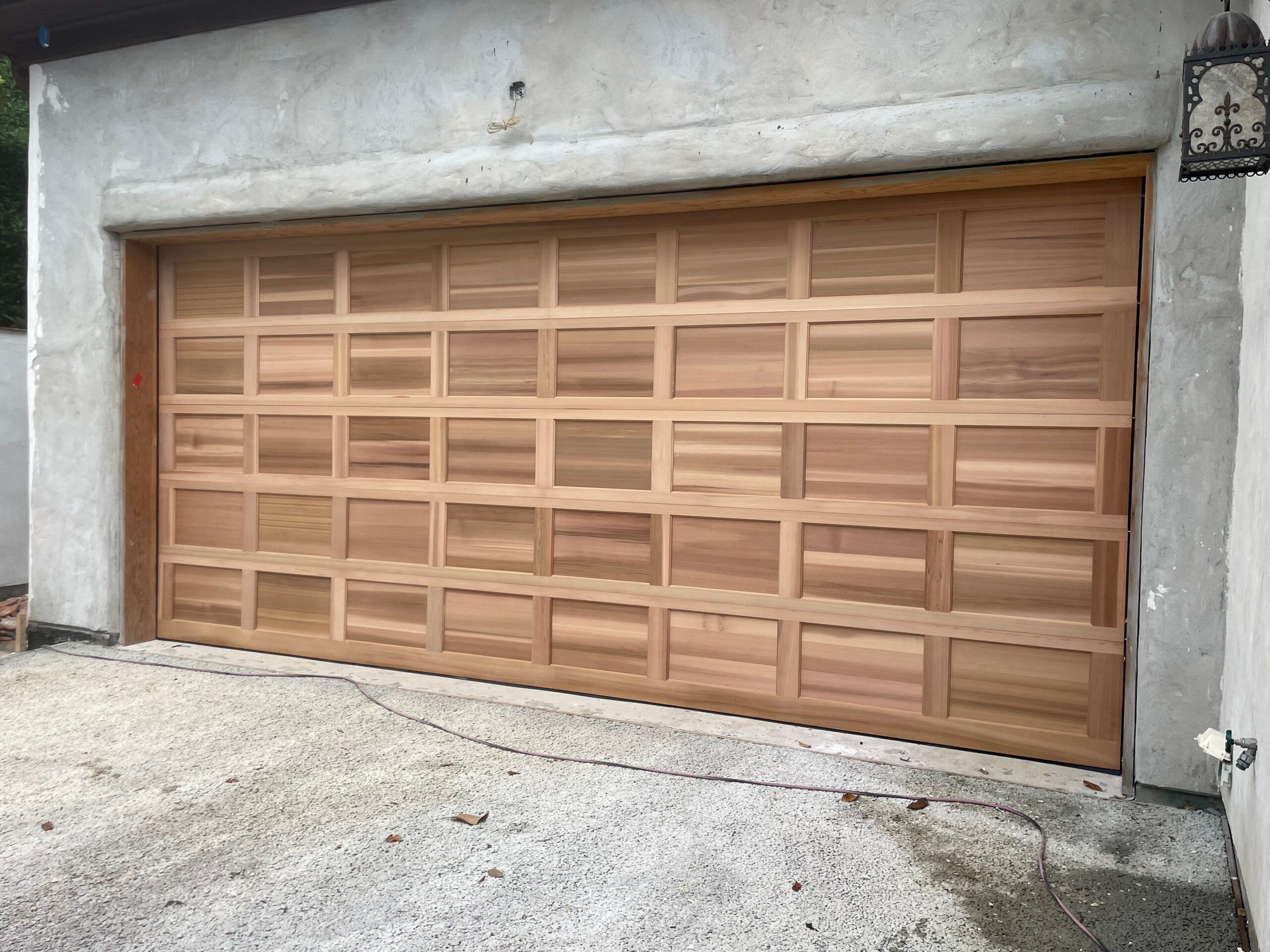
Material type. Wood, steel, composite, and aluminum are all options in DFW, but HOAs often restrict the list. Some prohibit natural wood. Some allow wood only with specific staining. Some require steel with a wood-grain composite overlay as a substitute.
Window style and placement. If the original doors had specific window inserts (square, arched, sunburst), the ARC may require the replacement to match the same pattern.
Decorative hardware. Wrought-iron style hinges, handles, and studs are sometimes required in carriage-style communities. Sometimes they’re prohibited in modern-style communities. Either way, the rule is usually in writing.
Manufacturer approval. Some HOAs maintain a list of approved door manufacturers or specific models. Buying a door outside the list is a violation regardless of how good it looks.
What HOAs Typically Cannot Do
The Texas Property Code and the typical HOA declaration set some boundaries on what an ARC can demand.
Force a specific installer or brand exclusively. In most cases, an HOA can require a specific door model, color, and material, but cannot legally require you to use a particular installation company. Anti-tying provisions in Texas law limit this.
Force replacement of a functional door. If your door works, looks reasonable, and meets the original architectural standards, the HOA generally cannot force you to replace it just because newer options exist.
Override city or county building codes. If a city code requires a specific wind rating, fire rating, or insulation standard, the HOA cannot force you to ignore the code.
Change the rules mid-project without notice. If you have an approved ARC submission, the HOA generally cannot retroactively apply new rules to your project. There are exceptions, but the principle holds.
Charge arbitrary fees beyond what’s in the declaration. Most HOAs charge a small review fee for ARC submissions, but it has to be in the governing documents.
These boundaries are general, not absolute. A few well-written HOA declarations can stretch the limits, and some rules have changed in court over the years. The safe move is to read your specific CC&Rs.
The Approval Process in Practice
A typical North Texas ARC submission for a garage door goes like this.
Step 1: Pull together the spec sheet. The door manufacturer or your installer will provide a specification sheet with the model, color (often a code like “Ranch Color Brown”), construction details, window style, and insulation rating. Most ARC submissions require this document.
Step 2: Pull together the photo or elevation. A front-of-house photo with the proposed door digitally overlaid, or a side elevation drawing showing the door in place. Some HOAs require a specific drawing scale or an architect’s stamp; most don’t.
Step 3: Submit the ARC form. Most HOAs use a standard form, available on the management company’s portal. Attach the spec sheet and the photo or drawing. Pay the review fee if there is one.
Step 4: Wait. Typical review time is 7-30 days. Many HOAs meet monthly. If you submit on the wrong side of a meeting, you may wait an extra 30 days.
Step 5: Receive approval (or rejection with reason). A rejection has to cite the specific rule you’re violating. If the rejection is vague, you can ask for the specific language in the CC&Rs that the door doesn’t meet.
Step 6: Install and request a final inspection. Some HOAs send someone to verify the installed door matches the approved spec.
Common Reasons for Violation Notices in DFW
A few things trip up homeowners in North Texas more than anything else.
Faded or peeling paint. Especially on wood doors that haven’t been refinished in a decade. The door may be perfectly functional, but the cosmetic condition is what triggers the notice.
Dented panels. A door that has been hit by a car, a basketball, or hail damage that was never repaired.
Broken springs left unaddressed. A door that won’t open or close properly, or that hangs unevenly.
Mismatched replacement doors. A homeowner replaces just one of two doors, or replaces a door with a different style than the original.
Commercial-looking doors in residential areas. Roll-up steel doors or industrial-looking doors installed in a residential community.
Unapproved door installed without ARC review. This is the most common. The homeowner bought a door, had it installed, and didn’t realize ARC approval was required.
What to Do If You Get a Violation Notice
A violation notice is not a legal action. It’s the HOA’s first step in a process. Here’s how to respond well.
Read the cited rule. The notice should cite a specific section of the declaration or a specific architectural standard. Read the language exactly. If it doesn’t cite a rule, ask for the specific rule in writing.
Request the source document. You have a right to see the CC&Rs and the architectural guidelines. Most management companies will email these without friction.
Respond within the window. Most notices give you 10-30 days to respond or remedy. Don’t ignore the deadline. A late response can trigger fines.
Propose a remedy. If the violation is real (faded paint, dented panel, broken spring), commit to a fix with a timeline. Most HOAs will work with you as long as you’re responsive.
Appeal if the rule doesn’t apply. If the cited rule doesn’t actually cover your situation, write a polite response explaining why and request that the violation be withdrawn. Keep it factual and brief.
Escalate if needed. If the HOA is unreasonable and your CC&Rs support your position, the next steps are a formal appeal to the board and, if that fails, mediation or arbitration under Texas Property Code. Most disputes never get this far.
The “Wood-Look Steel” Trick
One useful pattern in North Texas HOAs: many communities that ban natural wood will explicitly allow steel doors with a wood-grain composite or stamped finish. You get the visual warmth of wood without the maintenance, and the ARC often has a list of approved wood-look steel models.
If you’re replacing an aging wood door, ask your installer about wood-look composite or steel options. It’s a common solution and most ARCs are familiar with it.
How a Good Installer Helps
A garage door company that has worked in Trophy Club, Southlake, Flower Mound, Frisco, and Keller for years will know:
- Which colors and styles the local HOAs typically approve
- The standard ARC submission format each community uses
- Which manufacturers are on the approved list for which neighborhoods
- The realistic review timeline for each management company
This isn’t formal. Most installers can’t speak to the ARC on your behalf, but their experience saves you from learning the hard way that your door is the wrong color or the wrong window style.
The Bottom Line
HOA garage door rules in North Texas are real, they’re enforced, and they’re worth respecting. But the rules are also written down, and they have to follow the same Texas Property Code that you do. Read your CC&Rs, submit your ARC request before you buy, and pick a garage door company that has worked in your community before.
If you’re in the DFW area and want help choosing a door that your HOA will approve, or need a second opinion on a violation notice you’ve received, Meadows Garage Doors serves Trophy Club, Southlake, Flower Mound, Keller, Frisco, and the surrounding communities. Work is done by the people who own the business, fully licensed and insured, and never subcontracted.